
Ahead of the municipal elections, I argued that Emmanuel Grégoire (Socialist Party - Left) was the best positioned to win - not only because of polling dynamics, but because of the fragmentation on the Right and the historic Paris leaning toward the Left.
Emmanuel Grégoire was elected with 50.5% despite the centrist and far-right candidates - Pierre-Yves Bournazel and Sarah Knafo - withdrawing in the second round in favour of Mrs. Rachida Dati (Right), who came second with only 40.5%. Mr. Bournazel refused to be part of a common list with Mrs. Dati and instead sent his colleagues and advisors. On the other hand, Mrs. Knafo’s offer for a formal "Union of the Right" was declined by Mrs. Dati, determining the far-right politician to step down and request her voters to support "the Right", and not Rachida Dati. These last-minute half-rallies to Mrs. Dati could not change Parisians’ perception of the Right’s deep divisions.
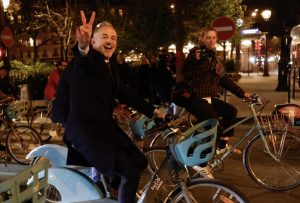
Emmanuel Grégoire’s bicycle arrival at the Paris Hôtel de Ville on the night of his election is symbolic. His plan is to accelerate the transition toward a more sustainable, green, and liveable metropolis for its residents - an “urban village”.
Housing: toward a dual market
Grégoire has committed to expanding social housing to 30% of Paris stock and mid-income housing (logement intermédiaire - rent-capped units targeting middle-income households) to 10%. This is a structural intervention with clear market effects: a reduction in available free-market housing stock, upward pressure on prices, and a progressive segmentation between regulated and non-regulated housing. Such a shift is also likely to affect neighbourhood commerce, as shops will need to adapt to a clientele with lower purchasing power.
The new Paris Mayor wants to push the short-term and tourist rentals into the long-term free market by declaring war on Airbnb and other rental platforms. For expats, this matters directly - furnished short-term rentals are a common landing pad when relocating to Paris, and that buffer is likely to shrink. The conversion of short-term rentals into long-term housing will provide some relief, but likely not enough to offset the structural imbalance created by extensive social housing.
The result is a shift toward a dual housing market: a regulated segment, largely inaccessible to private investors, and an increasingly scarce private segment, commanding premium prices.
The impact on office spaces and economic activity
Emmanuel Grégoire is counting on redirecting planned office developments toward residential use. For existing office stock, his approach relies on incentives - encouraging office real estate owners to convert their assets. Such conversions will reduce supply in certain segments, especially obsolete and non-ESG-compliant offices. The ambition is to recover some 700,000 to 800,000 sqm of office space over the coming years, but the Mayor has little leverage over the owners to force a change of use for their properties. The practical impact on office supply will therefore be gradual rather than structural.
As vehicle mobility becomes more difficult and as prime office space becomes more constrained, economic activity - especially among smaller firms - is likely to continue shifting toward Greater Paris: the Saclay platform, Vélizy, La Défense (Courbevoie), and Satory (Versailles) areas. Location will therefore become an even more important competitiveness factor for businesses.
Transport and mobility – toward the “urban village”
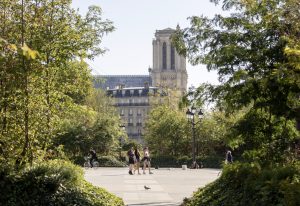
The “village” concept that former Mayor Anne Hidalgo tried to champion for Paris will be further developed. More and more traffic lanes will be converted for walking, buses and bicycle use. The goal of the Grégoire administration is to make access to Paris by car costly and time consuming enough to progressively discourage private car use in favor of public transport and soft mobility. Reducing car access to the capital will likely shift congestion onto the ring road and into neighbouring municipalities - many governed by mayors with very different political priorities. Coordinating a coherent regional mobility policy will require sustained negotiation with the Île-de-France region and the Métropole du Grand Paris, both outside Emmanuel Grégoire’s direct control. Prices of residential underground parking lots will decrease significantly as demand will drop. What was once a valuable asset may become a liability.
*
Paris will become an increasingly regulated environment for business. Prime private real estate will remain scarce and continue to command premium prices. For restaurants, cultural industries, car-sharing services, local retail, and leisure businesses, this creates opportunities. For traditional office real estate and car-dependent businesses, it will become a structural headwind –many companies will be forced to make a strategic choice between staying in Paris or relocating outside.
The city's fundamentals - its cultural dominance, infrastructure, international profile - will only become more visible.