What Will Emmanuel Grégoire’s Paris Look Like? Sustainability and Scarcity in an “Urban Village”
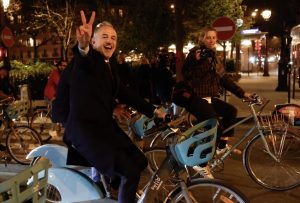
Emmanuel Grégoire celebrating his election as Paris Mayor, March 22, 2026.

Emmanuel Grégoire celebrating his election as Paris Mayor, March 22, 2026.

Ahead of the municipal elections, I argued that Emmanuel Grégoire (Socialist Party - Left) was the best positioned to win - not only because of polling dynamics, but because of the fragmentation on the Right and the historic Paris leaning toward the Left.

Emmanuel Grégoire was elected with 50.5% despite the centrist and far-right candidates - Pierre-Yves Bournazel and Sarah Knafo - withdrawing in the second round in favour of Mrs. Rachida Dati (Right), who came second with only 40.5%. Mr. Bournazel refused to be part of a common list with Mrs. Dati and instead sent his colleagues and advisors. On the other hand, Mrs. Knafo’s offer for a formal "Union of the Right" was declined by Mrs. Dati, determining the far-right politician to step down and request her voters to support "the Right", and not Rachida Dati. These last-minute half-rallies to Mrs. Dati could not change Parisians’ perception of the Right’s deep divisions.

Emmanuel Grégoire’s bicycle arrival at the Paris Hôtel de Ville on the night of his election is symbolic. His plan is to accelerate the transition toward a more sustainable, green, and liveable metropolis for its residents - an “urban village”.

Housing: toward a dual market

Grégoire has committed to expanding social housing to 30% of Paris stock and mid-income housing (logement intermédiaire - rent-capped units targeting middle-income households) to 10%. This is a structural intervention with clear market effects: a reduction in available free-market housing stock, upward pressure on prices, and a progressive segmentation between regulated and non-regulated housing. Such a shift is also likely to affect neighbourhood commerce, as shops will need to adapt to a clientele with lower purchasing power.

The new Paris Mayor wants to push the short-term and tourist rentals into the long-term free market by declaring war on Airbnb and other rental platforms. For expats, this matters directly - furnished short-term rentals are a common landing pad when relocating to Paris, and that buffer is likely to shrink. The conversion of short-term rentals into long-term housing will provide some relief, but likely not enough to offset the structural imbalance created by extensive social housing.

The result is a shift toward a dual housing market: a regulated segment, largely inaccessible to private investors, and an increasingly scarce private segment, commanding premium prices.

The impact on office spaces and economic activity

Emmanuel Grégoire is counting on redirecting planned office developments toward residential use. For existing office stock, his approach relies on incentives - encouraging office real estate owners to convert their assets. Such conversions will reduce supply in certain segments, especially obsolete and non-ESG-compliant offices. The ambition is to recover some 700,000 to 800,000 sqm of office space over the coming years, but the Mayor has little leverage over the owners to force a change of use for their properties. The practical impact on office supply will therefore be gradual rather than structural.

As vehicle mobility becomes more difficult and as prime office space becomes more constrained, economic activity - especially among smaller firms - is likely to continue shifting toward Greater Paris: the Saclay platform, Vélizy, La Défense (Courbevoie), and Satory (Versailles) areas. Location will therefore become an even more important competitiveness factor for businesses.
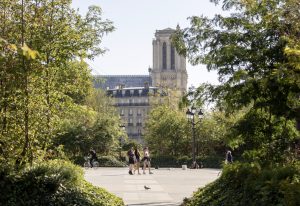
Paris, March 2026. An urban garden "transplanted" in front of the Paris Hôtel de Ville.

Paris, March 2026. An urban garden "transplanted" in front of the Paris Hôtel de Ville.

Transport and mobility – toward the “urban village”

The “village” concept that former Mayor Anne Hidalgo tried to champion for Paris will be further developed. More and more traffic lanes will be converted for walking, buses and bicycle use. The goal of the Grégoire administration is to make access to Paris by car costly and time consuming enough to progressively discourage private car use in favor of public transport and soft mobility. Reducing car access to the capital will likely shift congestion onto the ring road and into neighbouring municipalities - many governed by mayors with very different political priorities. Coordinating a coherent regional mobility policy will require sustained negotiation with the Île-de-France region and the Métropole du Grand Paris, both outside Emmanuel Grégoire’s direct control. Prices of residential underground parking lots will decrease significantly as demand will drop. What was once a valuable asset may become a liability.

                                                                                                                 *

Paris will become an increasingly regulated environment for business. Prime private real estate will remain scarce and continue to command premium prices. For restaurants, cultural industries, car-sharing services, local retail, and leisure businesses, this creates opportunities. For traditional office real estate and car-dependent businesses, it will become a structural headwind –many companies will be forced to make a strategic choice between staying in Paris or relocating outside.

The city's fundamentals - its cultural dominance, infrastructure, international profile - will only become more visible.

Macron’s “Choose Europe for Science” Initiative - A Real Solution or Another EU - US Flashpoint?

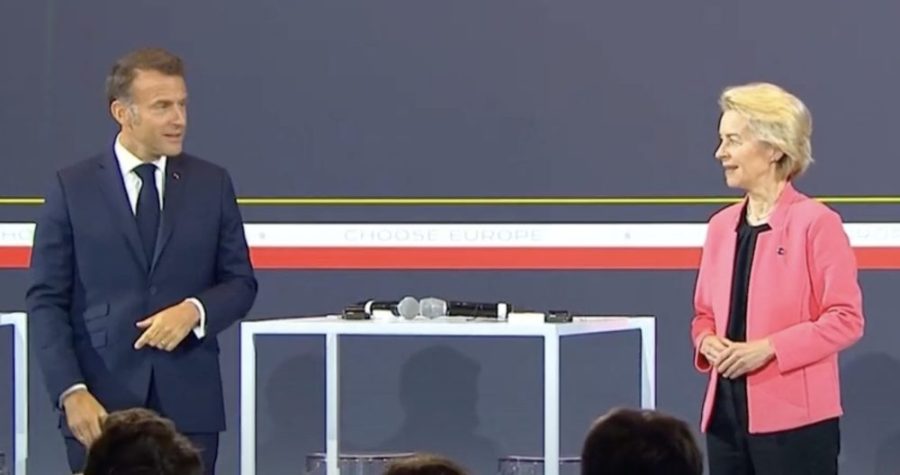
French President Emmanuel Macron and EU Commission President Ursula von der Leyen in Sorbonne University, Paris, May 5, 2025

French President Emmanuel Macron and EU Commission President Ursula von der Leyen in Sorbonne University, Paris, May 5, 2025

On May 5, President Macron and European Commission President Ursula von der Leyen gathered in Macron’s favourite venue for big speeches - the ancient convent of Sorbonne University, in Paris - to launch his latest initiative, “Choose Europe for Science.” The goal is to attract US researchers affected by Trump-era budget cuts and the increasingly challenging research environment in the US.

Von der Leyen announced €500 million in EU funding, while Macron pledged €100 million investment to stimulate the arrival of foreign researchers. Additionally, von der Leyen declared that EU member states will be required to allocate 3% of their GDP to R&D investment. The two leaders portrayed the EU as a “land of freedom” for scientists, with von der Leyen revealing plans for a European Act to enshrine the freedom of scientific research into law.

In France, Aix-Marseille University has already announced plans to select 15-20 lead researchers, each receiving between €0.6 and €0.8 million budgets over three years. However, the university has not specified which disciplines will be targeted.

Despite the fanfare, the initiative has sparked dissatisfaction - particularly among French researchers who recently faced €500 million in domestic budget cuts. French senator Pierre Ouzoulias, himself a CNRS researcher, criticized the plan as inconsistent with France’s national policy of cutting research funds.

In Italy, Prime Minister Giorgia Meloni is reportedly upset for two reasons: the initiative spotlights France as the primary destination for US researchers, and it risks deepening the rift between the US and Europe - a divide she has been working to bridge. According to La Stampa, Meloni even asked Italian university presidents not to attend the “Choose Europe for Science” Summit to avoid signaling an endorsement of Macron’s plan. Nonetheless, Macron and von der Leyen both highlighted Italian Bologna University as a European beacon of knowledge.

Macron’s summit seems primarily aimed at capturing the spotlight. It remains unclear how France’s €100 million budget will be allocated in concrete terms, but it is expected to finance around 150 projects and attract a maximum of 500 researchers - a modest figure compared to the CNRS’s 32,000 researchers. The political substance of the summit was underscored by Macron’s open criticism of US policies toward researchers, which he described as “an error.” However, perhaps the most consequential announcement in Paris came from von der Leyen, who pledged that EU member states would allocate a minimum of 3% of GDP to R&D - a level that would surpass both China and the post-cut US. The bad news is that research is not an EU competence, so this percentage can hardly be imposed to the EU member states. On top of that, EU countries that are also NATO members already face tight budgets and growing pressure from Trump’s demand to raise defense spending to 5% of GDP.

President Macron’s move underscores how geopolitical competition is expanding into areas that were more or less preserved. A new term is emerging - “scientific asylum” - which suggests that nationality is starting to replace merit, brilliant ideas and hard work in the field of research.  It is also a brutal wake-up call for young people who dedicated their energy and talent to pursuing their dreams.

A New Internal Security Challenge: What Could Violence Against Prisons and Prison Staff Trigger?

Burned cars belonging to prison staff in front of the Tarascon Prison. April 16, 2025

Burned cars in front of the Tarascon Prison. April 16, 2025

During the last two weeks, a new campaign of violence surfaced in France: coordinated attacks against prisons and prison guards. Beyond the immediate threat to public security, this wave of violence risks is destabilizing an already fragile political landscape - forcing the French government to act fast and efficient.

Between April 13 and April 21, eight prisons, four residential buildings housing prison staff, and personal vehicles belonging to prison staff members were attacked. Investigations have been opened on charges of “terrorist association for one or more crimes against individuals” and “attempted assassination of a person vested with public authority”. Who is behind this wave of violence? Why is it directed exclusively at prison staff and not at other police forces? How far can it escalate?

This new crisis emerges in an already fragile security environment. Since the 2015 terrorist attacks, the French army, gendarmerie, and police forces have experienced a significant surge in workload. With detainee numbers at an all-time high, prison staff have reported exhaustion and increased psychological stress. Many officers are on medical leave, which further strains their colleagues. A major shock occurred in May 2024: a van belonging to the prison administration was ambushed during a detainee transfer. Two prison officers were killed, and the escorted drug baron, Mohammed Amra, escaped — only to be captured nearly a year later in Romania.

The perpetrators of this new wave of violence call themselves the “Defense of the Rights of French Prisoners” (DDFP). They claim to denounce “violations of fundamental rights that French Justice Minister Gérald Darmanin intends to impose”. On the other hand, the Minister argues that the drug mafia is behind these acts, retaliating against the "Narcos Law" promoted by the French National Assembly. Two "super-prisons" for drug lords will be created, after the Italian prison model for the convicted Mafia bosses. Once passed, this law will prevent arrested drug leaders to continue conducting their businesses, ordering murders and kidnappings, and threatening people outside. The use of a Kalashnikov assault rifle during the attack on Toulon prison and the timing of these attacks during the parliamentary procedure of the "Narcos Law" come to support the Minister’s accusations.

This somehow unexpected escalation of violence complicates France’s already volatile political landscape, especially amid the rising popularity of the far-right National Rally and its allies. The French government must take strong action to avoid an all-out confrontation, similar to Italian Cosa Nostra's “war against the State” - particularly because it is accused of complacency towards criminality by the opposition forces. Both the Justice Minister and the Interior Minister hide presidential ambitions for 2027. Justice Minister Gérald Darmanin has therefore seized the opportunity to launch a major counter-offensive. Nearly 200 investigators have been mobilized, and elite units from the Ministry of Interior have been assigned to this case. As a result, twenty-five suspects were arrested on Monday, April 28.

From a business perspective, if the conflict between drug gangs and authorities escalates and spreads into downtown areas of French cities, it could severely impact tourism, catering, and real estate prices. Even localized violence in the suburbs would increase security costs for stores and banks, and drive up insurance premiums for businesses and vehicles. Already under fiscal pressure, the French government cannot afford to lose revenues from weakened economic activity and investor hesitation. Containing this security crisis swiftly is not only a political imperative, but also an economic one.

Abolition of the Death Penalty - François Mitterrand's Moment of Truth

"I am not in favour of the death penalty"

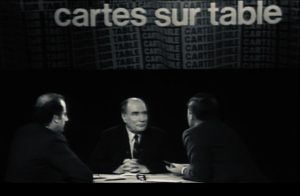
More than 40 years ago, on the 16th of March 1981, François Mitterrand was invited to a famous French political talk show called "Cartes sur table/Cards on the table", as its homonym novel signed by Agatha Christie. It was to be one of the last editions of the show hosted by Jean-Pierre Elkabbach and Alain Duhamel since 1977. The pre-electoral campaign for the French presidential elections was in full swing, with a first round scheduled on April 26, 1981.

For 64 year old Mitterrand, who previously lost two presidential elections (1965 and 1974), the upcoming election was almost certainly his last chance of becoming President. The polls were not very encouraging though: he was an underdog and acting President Giscard d'Estaing was the favourite.

The talk show went smoothly until the penultimate question, raised by Alain Duhamel: "There are currently 5 people sentenced to death and imprisoned in France. Will you pardon them (if elected)?"

This was a delicate question: it was about head of state prerogatives conflicting with the need for justice, and it was also about François Mitterrand's past, because as a young Justice Minister he did not oppose to executions of convicted criminals.

However, Mitterrand's answer was masterful: "As for the other issues, I will not hide my thoughts on this one. From the depth of my conscience, that rejoins that of the Churches - the Catholic and Reformed Churches, the Jewish religion and all the important humanitarian associations, I am against the death penalty. And I don't need to read the polls, that state the opposite: the majority of the opinions expressed is in favour of the death penalty.

Very well, I am candidate at the Presidency of the French Republic, and I request the majority of the votes of French people, but I do not request it through hiding my thoughts. I speak what I think, what I endorse, what I believe in, what my spiritual allegiances are, my belief, my caring about civilization. I am not in favour of death penalty".

François Mitterrand was often accused by the press and political competitors of being "a very secretive person". This statement made him look honest and true in front of the millions watching him. In his answer, he skilfully started by saying that "as for the other issues" he has nothing to hide on this one - a formula meant to dismiss the accusations of vagueness in many of his proposals and previous statements. He also underlined that his beliefs are those of the Catholics, Protestants and Jews of France, this way targeting a very wide basket of possible voters that traditionally were more conservative and less inclined to vote for a Socialist champion, such as Mr. Mitterrand. His powerful words were further strengthened by his look straight to the camera. François Mitterrand won his bet: French people saw that night a statesman who is ready to go against public opinion and possibly lose the presidential elections only to remain true to his beliefs.

Less than two months after this show, on May 10, 1981, Mitterrand was elected President of the French Republic. On September 18, 1981, the French National Assembly voted the draft law abolishing the death penalty, submitted by Mr. Mitterrand's government. The evening show statement became law.

Years after, Mitterrand confessed to his interviewer Alain Duhamel that his question helped him to be elected President.