
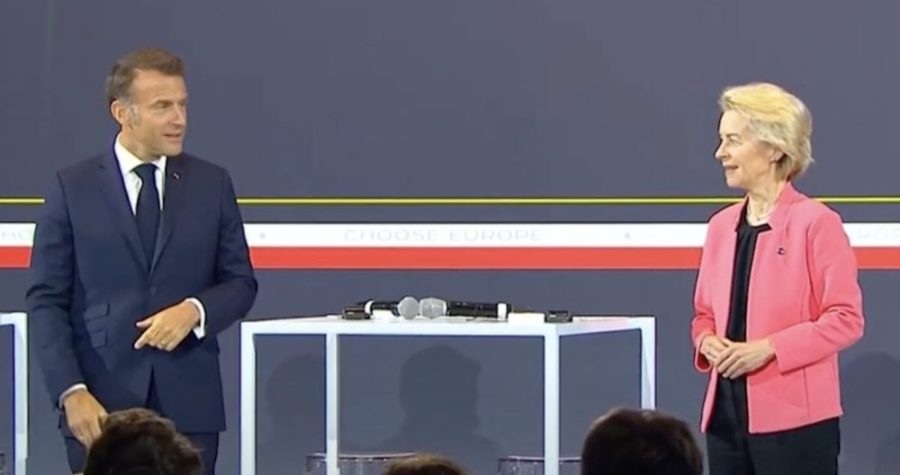
On May 5, President Macron and European Commission President Ursula von der Leyen gathered in Macron’s favourite venue for big speeches - the ancient convent of Sorbonne University, in Paris - to launch his latest initiative, “Choose Europe for Science.” The goal is to attract US researchers affected by Trump-era budget cuts and the increasingly challenging research environment in the US.
Von der Leyen announced €500 million in EU funding, while Macron pledged €100 million investment to stimulate the arrival of foreign researchers. Additionally, von der Leyen declared that EU member states will be required to allocate 3% of their GDP to R&D investment. The two leaders portrayed the EU as a “land of freedom” for scientists, with von der Leyen revealing plans for a European Act to enshrine the freedom of scientific research into law.
In France, Aix-Marseille University has already announced plans to select 15-20 lead researchers, each receiving between €0.6 and €0.8 million budgets over three years. However, the university has not specified which disciplines will be targeted.
Despite the fanfare, the initiative has sparked dissatisfaction - particularly among French researchers who recently faced €500 million in domestic budget cuts. French senator Pierre Ouzoulias, himself a CNRS researcher, criticized the plan as inconsistent with France’s national policy of cutting research funds.
In Italy, Prime Minister Giorgia Meloni is reportedly upset for two reasons: the initiative spotlights France as the primary destination for US researchers, and it risks deepening the rift between the US and Europe - a divide she has been working to bridge. According to La Stampa, Meloni even asked Italian university presidents not to attend the “Choose Europe for Science” Summit to avoid signaling an endorsement of Macron’s plan. Nonetheless, Macron and von der Leyen both highlighted Italian Bologna University as a European beacon of knowledge.
Macron’s summit seems primarily aimed at capturing the spotlight. It remains unclear how France’s €100 million budget will be allocated in concrete terms, but it is expected to finance around 150 projects and attract a maximum of 500 researchers - a modest figure compared to the CNRS’s 32,000 researchers. The political substance of the summit was underscored by Macron’s open criticism of US policies toward researchers, which he described as “an error.” However, perhaps the most consequential announcement in Paris came from von der Leyen, who pledged that EU member states would allocate a minimum of 3% of GDP to R&D - a level that would surpass both China and the post-cut US. The bad news is that research is not an EU competence, so this percentage can hardly be imposed to the EU member states. On top of that, EU countries that are also NATO members already face tight budgets and growing pressure from Trump’s demand to raise defense spending to 5% of GDP.
President Macron’s move underscores how geopolitical competition is expanding into areas that were more or less preserved. A new term is emerging - “scientific asylum” - which suggests that nationality is starting to replace merit, brilliant ideas and hard work in the field of research. It is also a brutal wake-up call for young people who dedicated their energy and talent to pursuing their dreams.